Annabelle, the dexterous heroine of Barnett and Klassen’s “Extra Yarn,” inhabits a monochrome world of grays and browns until she finds a box of brightly colored yarn in the snow. When the rainbow sweater she knits herself is a distraction at her humdrum school, she promises to knit sweaters for the whole class. “Impossible,” her teacher says. “You can’t.”
But Annabelle does, and the magical box of yarn just won’t run out, even after she knits sweaters for everyone in town, and then for the local animals and buildings. Klassen’s illustrations are the most absorbing part of this tale, wrapping Annabelle’s sooty, snowy town in mottled color and texture as her knitting progresses.
Alas, the story’s central conflict — the interference of a greedy archduke who appears out of nowhere to demand the yarn for himself — feels out of place, as the theme of creativity trumping negativity was already pleasing on its own. The second act also raises more questions than it answers. For example, it’s unclear why the archduke wants the yarn.
Sunday, February 19, 2012
Plant a Kiss
This very girly tale about a “Little Miss” who plants a kiss pairs the best-selling author Rosenthal (“Little Pea,” “Duck! Rabbit!”) and the award-winning illustrator Reynolds (“Ish,” the Judy Moody series) for the first time, with great success. Splashes of sparkle adorn the pages as the seedling kiss causes “doubt” and a “pout” before it sprouts and spreads in a cheery wash of yellow and pink. Rosenthal’s and Reynolds’s straightforward and gently humorous sensibilities are well matched in this story about love beyond the boundaries of parent and child.
And what child doesn’t like a page sprinkled in glitter?
A Boy Called Dickens
This story concentrates entirely on the Dickens' time at Warren’s, the blacking factory, where 12-year-old Dickens went to work making shoe polish to support his family. The book follows Dickens’ daily routines and traversal of the city. Hopkinson proposes that during this time Dickens was dreaming the stories which became his novels.
Week Eight - 44 to Go
Mick Manning and Brita Granstrom take us through the whole life of Charles Dickens. Culling the biographical literature on Dickens, the authors tell of incidents involving Dickens with all sorts of striking detail.
Sunday, February 12, 2012
Week Seven - 45 to Go
In this police procedural Hennessey and Yellich take on the devil in his guise as the "False Knight". Turnbull turns his writing up a notch.
Wednesday, February 8, 2012
Samite - Musician - In Concert
The doors of the Irene A. Bisgrove Community Theatre were opened by a coed at exactly 10:50 AM. An audience of 75 quickly took their seats throughout the auditorium. English Professor Howard Nelson speaking from center stage and explained the Robert H. Brunell Visiting Scholar in the Humanities program at Cayuga Community College. Nelson then proceeded to introduce the 2012 Brunell Visiting Scholar Samite Mulondo.
The Uganda native picked up an electric thumb organ and began to play.
Since the audience seem to be sitting on their emotions, Samite told them when listening to African music it was alright to move one's head and clap one's hands. Using a call and response technique Samite got the crowd to loosen up.
Choosing a kalimba, an African thumb piano, Samite explained that it was very, very old. Also, it had been autographed by Paul Simon. Samite joked that this kalimba was his retirement.
Pleased with the crowd attentiveness Samite played a new instrument for the first time in public.
The concert came to an end with the audience dancing and clapping in the aisles.
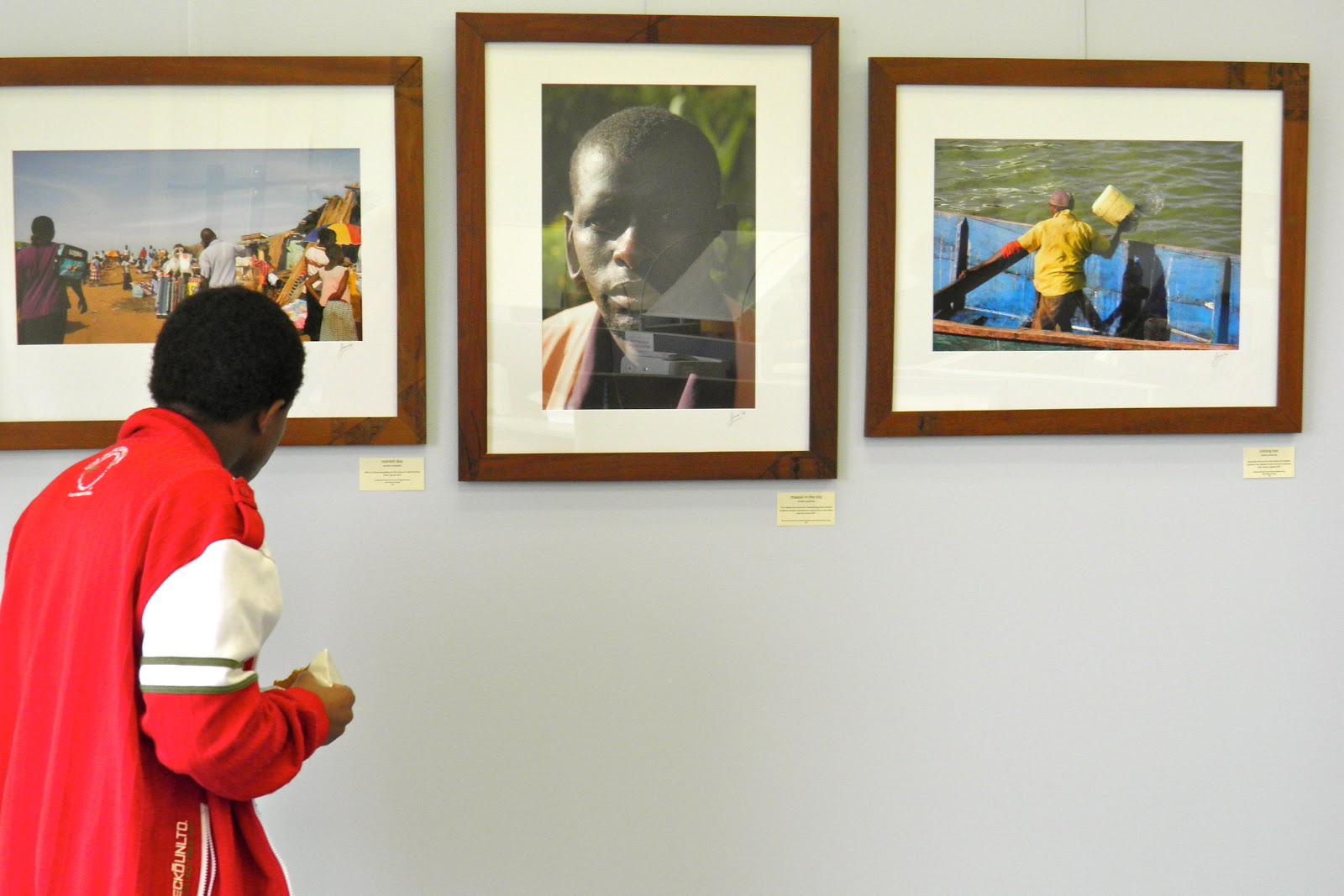
This afternoon at 2 PM Samite will speak at the opening of his photography exhibition in the Cayuga Community College Library.
Samite - Photographer - Photo Exhibition
Samite Mulondo
Samite began by pointing to three photos of young African boys. These young boys have been terrorized. Some have been made into boy soldiers. For many the only home they know is a refuge camp. In his description of the boys' lives, Samite put forth an unyielding attitude that these kids deserve a second chance. It is this attitude that prompted Samite to bring his music to Africa's refugee camps.
Visiting a school Samite gave an instrument to the school principal. Although he could not play it, the students found his attempt amusing.
Standing in front of his photo of a waterfall, Samite admitted his phobia to water. He does not swim. Nevertheless bravely in stood in the water and took this photo. For him the photo represents life. In life there is calmness or smoothness than a rough patch followed by a smoothness which often we can not see.
According to Samite the fishermen's song would bounced across the waters. Samite noted that the blue lake, the blue background, and the blue sky is natural coloring not enhanced by PhotoShop.
Samite told that there are less than 700 mountain gorillas left. Humans are destroying their habitat. Hunters kill them for food. Trophy hunters take their hands as trophies. Using ranger escorts Samite visited a family of mountain gorillas. One observation that Samite made was how the gorillas both old and young are fascinated by their digits.

This morning at 11 AM Samite gave a music concert in the Irene A. Bisgrove Community Theatre.
Subscribe to:
Posts (Atom)